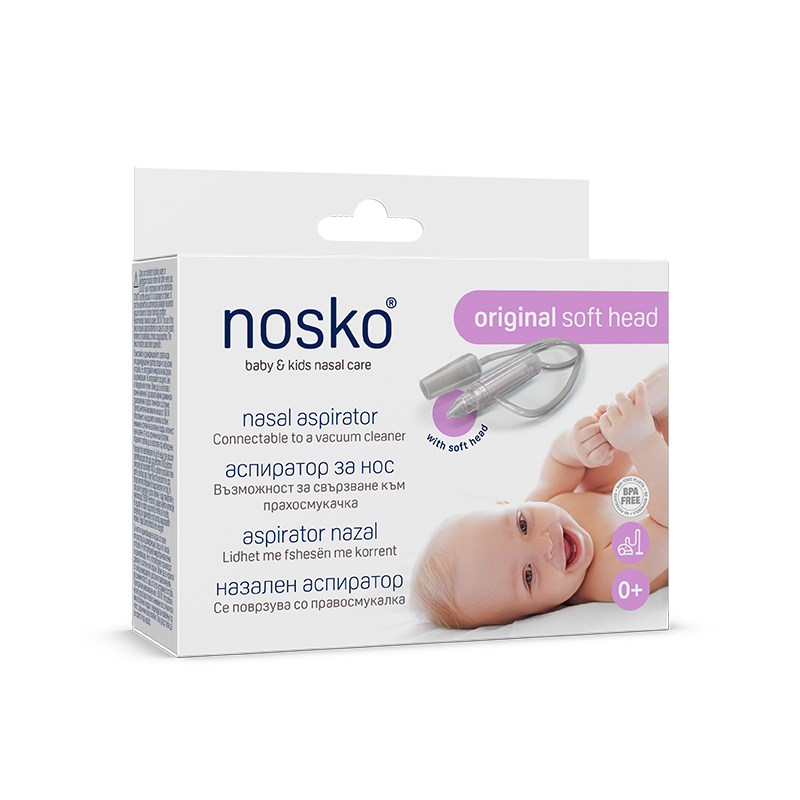
The Nosko nasal aspirator reduces the likelihood of complications developing from a common cold. It helps your child breathe more easily and feel calmer. It also facilitates breastfeeding, as a blocked nose can make feeding difficult and cause distress for both the child and mother.
Benefits of the soft tip:
- A gentler touch, suitable for newborn babies' sensitive noses
- Safe and convenient to use
- Made from heat-resistant material that is easy to clean
- Contains no materials harmful to health (BPA-free)
- A genuine innovation in nasal aspirators
The Nosko Vacuum Nasal Aspirator is a medical device used to remove nasal secretions quickly and gently with a standard household vacuum cleaner. Insert the cone-shaped end of the attachment into the vacuum-cleaner hose and place the other tip at your baby's or child's nostril. The Nosko Vacuum Nasal Aspirator removes secretions using constant, safe suction of 0.2 bar, irrespective of the vacuum cleaner's suction power. The procedure is completely painless and has no known side effects. The Nosko Vacuum Nasal Aspirator has been clinically tested and approved for use. It can shorten recovery time from colds, helping the child feed, drink and sleep more comfortably. It contains no materials harmful to health, can be dismantled for easier and more effective cleaning, and may be sterilised. It is made from biocompatible, medical-grade, BPA-free plastic that does not cause irritation or allergic reactions. Suitable for newborn babies.
Directions for use:
Before each procedure, it is advisable to rinse the nose with physiological saline. You can rely on Nosko 30 ml spray isotonic seawater solution.
Vacuum nasal cleaning – steps
1. Preparation: Plug the vacuum cleaner into the mains, then position it close to where the nasal cleaning will be carried out so that you can switch it on by hand or foot.
2. Assemble the device as shown in the leaflet and insert the bell-shaped connector into the vacuum-cleaner hose. Then switch on the vacuum cleaner.
3. Rinse with physiological saline. (A 0.9% saline solution is physiological and has the same composition as tears. It does not sting or irritate; it simply moisturises and thins the secretion.) After 3 minutes, removal of the moistened nasal mucus and thinned secretion may begin, allowing the nose to be cleaned safely by vacuum without injuring the mucous membrane.
4. Position the child correctly according to their age.
a) Vacuum nasal cleaning for newborn babies and infants
Raise the baby into a semi-seated position, supporting their back with your left forearm and holding their head upright in your palm. The baby must not be lying flat or have their head tilted backwards, as this makes the secretion more difficult to remove and may cause it to flow towards the throat. When the body is positioned correctly, the secretion flows towards the nose, allowing it to be removed quickly and effectively.
Newborn babies and infants do not usually have secretions thick or abundant enough to require a full vacuum, so there is no need to close the other nostril. In any event, this would be difficult at this age because the baby will immediately open their mouth when the device is placed in one nostril and the other nostril is closed.
b) Vacuum nasal cleaning for young children
Sit the child on your lap with their back towards you. Ask the child to lean their head forwards; this will help remove the secretion.
At this age, if the child is able to cooperate, you may close the other nostril with your fingers. This creates a full vacuum and allows the nose to be cleaned more quickly. A full vacuum provides faster, more effective cleaning but is not essential and should be used only when the child can cooperate. Ask the child to keep their mouth closed until you have finished cleaning the nose; this will help the procedure finish more quickly.
How vacuum nasal cleaning works: closing the nostril creates a vacuum in the nose, causing secretions to move from the middle nasal passage into the common nasal passage. Once the nostril is released, the secretion can be removed from the common nasal passage. This is particularly important when the secretion is thick. Liquid secretion flows naturally from the middle into the common nasal passage, where it can be removed easily with the nasal vacuum-cleaning device without creating a full vacuum.
5. Switch on the vacuum cleaner. Thanks to its design, the nasal vacuum-cleaning device maintains a constant suction pressure of 0.2 bar, which is safe even when cleaning a newborn baby's nasal cavity.
6. Place the suction tip in the nostril.
Positioning the device in the nostril and correct use
Hold the suction tip in your right hand with the silicone tube pointing upwards. This is important to prevent secretion from flowing into the tube. The device will then remain clean and only the suction tip and container, rather than the silicone tube, will need washing. Insert the suction tip into the nostril only as far as the cone-shaped end permits. There is no need to insert or press the device deeply, as this does not improve its effectiveness. Angle the suction tip downwards and to the side so that the secretion can be removed completely. A single continuous cleaning cycle must not exceed 5 seconds. If this is insufficient, alternate 5-second cleaning cycles with pauses of 3–5 seconds. Continue until secretion no longer collects in the container.
7. Remove the device from the nostril.
8. Switch off the vacuum cleaner.
9. Disconnect the device from the vacuum cleaner.
10. Dismantle the suction tip and wash it under running water. If necessary, it may be boiled or sterilised by another suitable method. Remove the suction tip from the container before cleaning. The tip itself may also be dismantled for more effective cleaning. The nasal vacuum-cleaning device separates into 5 parts, making it considerably easier to clean and maintain hygienically.
13. Once the parts are dry, keep them in a clean place so that they are ready for immediate use next time.
Caution:
Sterilise in boiling water before and after each use. NOT SUITABLE FOR USE IN A MICROWAVE OVEN.
Once dry, store assembled in a clean place.
Do not use the device in children who experience nosebleeds or have chronic haemophilia.
Do not leave the child unattended.
Contents:
Components of the nasal vacuum-cleaning device
Plastic
Suction tip;
Secretion container (an inner cylindrical container that can be detached from the suction tip; and an outer container to which the suction tip and, at the side, the silicone tube are attached);
Silicone tube (flexible);
Bell-shaped vacuum-cleaner connector
Manufacturer: Ranyak Georgy, Hungary.